Dental visits
Oral appliances for sleep apnea: testing, CPAP and SomnoDent Avant
Explore oral appliances for sleep apnea in Calgary, including home sleep testing, CPAP comparisons, iTero scans and SomnoDent Avant at Dental at the Bow.
TL;DR
A custom oral appliance may help some adults with obstructive sleep apnea, including mild cases. Suitability starts with a diagnosis and assessment.
If CPAP is difficult to tolerate, discuss alternative treatment with your sleep care team before making a change.
Dental at the Bow works with My Sleep Services for home sleep testing and discussion of treatment options. If an appliance is suitable and you choose it, the clinic takes an iTero scan and sends the records to SomnoMed. The usual appliance is SomnoDent Avant.
Treatment includes checking the response. Follow-up testing helps assess whether the appliance is controlling your sleep apnea.
Oral appliances for sleep apnea offer a treatment option worth discussing if you have mild obstructive sleep apnea or find CPAP difficult to use. At Dental at the Bow in downtown Calgary, the process connects sleep testing and an options discussion with digital scanning for a custom appliance when appropriate.
You do not need to arrive having chosen a device. The first step is understanding your diagnosis and which treatments fit your health needs.
How do oral appliances for sleep apnea work?
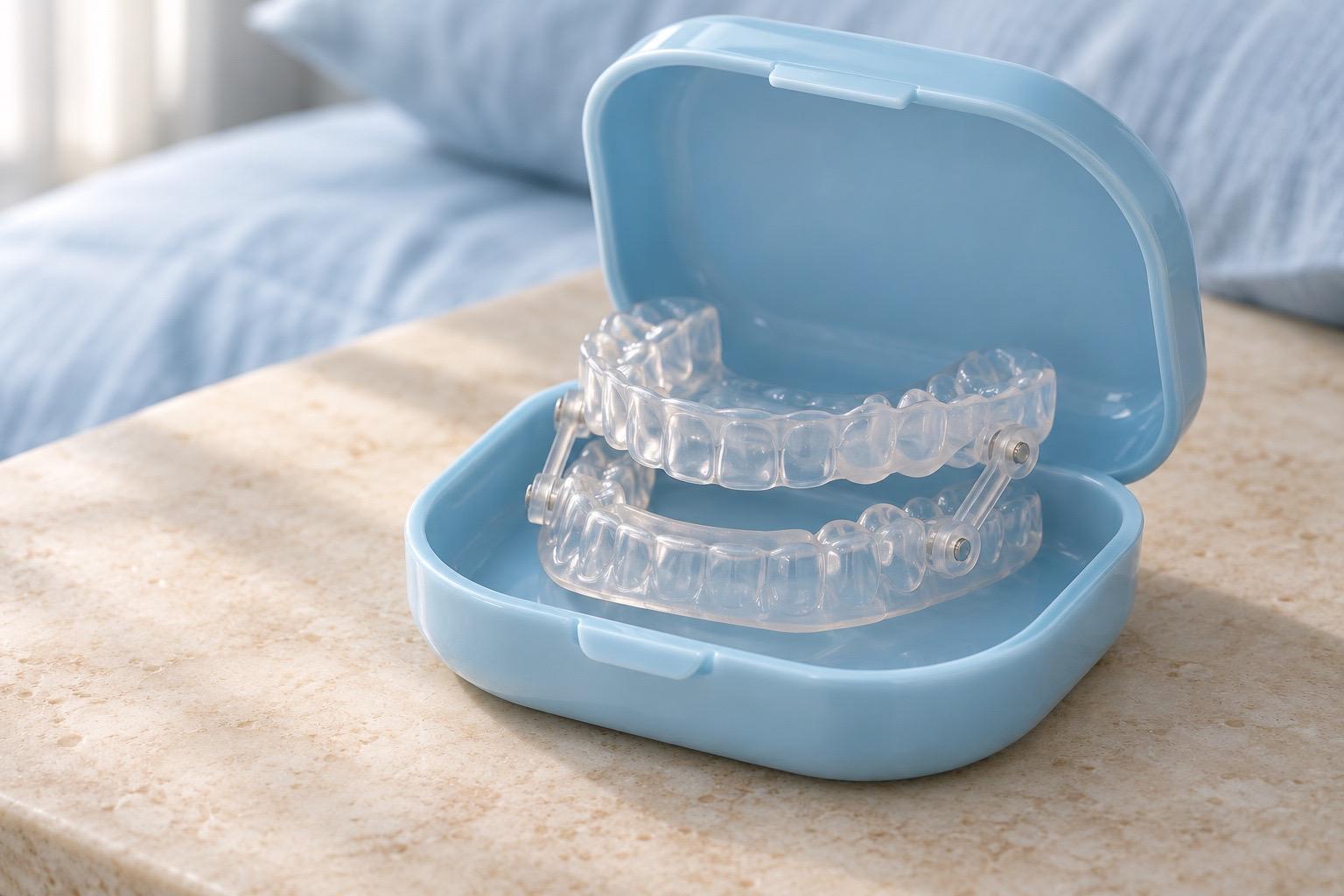
A mandibular advancement appliance holds your lower jaw forward while you sleep to help keep your airway open. The National Heart, Lung, and Blood Institute explains how these oral devices help prevent the jaw from moving back and blocking the upper airway.
Obstructive sleep apnea involves repeated narrowing or blockage of the airway during sleep. It differs from central sleep apnea, which involves the brain's breathing signals. Snoring alone does not establish which condition, if any, you have.
For sleep apnea treatment, clinical guidance favours a custom, adjustable appliance. A standard grinding guard or sports mouthguard should not be substituted for the prescribed device.
Who can consider oral appliances for sleep apnea?
An oral appliance may be considered for adults with mild obstructive sleep apnea and for some people who cannot tolerate CPAP or prefer another treatment. The oral appliance guideline supports discussing alternatives with the treating sleep clinician rather than leaving diagnosed sleep apnea untreated.
Suitability is individual. Your sleep test findings and dental assessment both matter, including your teeth, gums, jaw joints and bite. The ADA describes the importance of dental assessment and ongoing monitoring when an appliance is being considered.
The option is not restricted to mild cases, but CPAP remains the primary treatment for severe obstructive apnea. An appliance in that situation needs careful clinical selection, particularly when CPAP has not been tolerated.
CPAP and oral appliances: what to compare
CPAP and a mandibular advancement appliance keep the airway open in different ways. CPAP therapy supplies pressurized air through a mask, while the appliance changes the position of the lower jaw.
| What to compare | CPAP | Custom oral appliance |
|---|---|---|
| How it works | Air pressure helps hold the airway open | The device holds the lower jaw forward |
| What you wear | A mask connected to a machine | An appliance fitted to your mouth |
| What to discuss | Mask fit, comfort and using the equipment consistently | Dental suitability, comfort, adjustment and monitoring |
The AASM and AADSM guideline found that CPAP generally produces a greater reduction in breathing interruptions. A smaller device is not automatically an equally effective choice for your particular sleep apnea.
Travel can still be part of the conversation. Alberta Health Services notes that an appliance can offer travel convenience, but convenience alone does not establish suitability. If travel or mask discomfort is making CPAP difficult, ask your sleep care team about the available options before changing treatment.
From home sleep testing to a SomnoDent Avant
Dental at the Bow works with My Sleep Services, which provides at-home sleep testing and consults with patients about options, including CPAP and oral appliances. This gives you a discussion about treatment before the dental scan stage.
1. Start with sleep testing and an options discussion
Testing helps establish the diagnosis and guide treatment. A home sleep test is appropriate for selected adults; some people need testing in a sleep laboratory instead. If a home result is negative, inconclusive or technically inadequate, the AASM recommends an in-lab sleep study rather than assuming sleep apnea has been ruled out.
Ask who will review your results, explain their meaning and oversee the medical treatment plan. A dental scan records your teeth; it does not diagnose sleep apnea.
2. Take an iTero digital scan
If an oral appliance is appropriate and you choose to proceed, Dental at the Bow takes a digital iTero scan. The clinic sends the digital records to SomnoMed for custom fabrication.
3. Have the appliance made by SomnoMed
The clinic typically uses SomnoDent Avant. SomnoMed describes the SomnoDent Avant as a custom appliance with upper and lower components designed from dental records, manufactured from dental acrylic and finished with a soft inner liner.
Ask the clinic about delivery, fitting, adjustment appointments and expected timing before proceeding. Those details belong in your individual treatment plan.
What follow-up does a sleep appliance need?
An appliance needs dental monitoring and follow-up assessment of your sleep apnea. The AASM recommends repeat sleep testing to assess the response to treatments such as an oral appliance. Less snoring or feeling better does not replace that check.
Possible appliance side effects include jaw discomfort, changes in saliva, irritation and changes to the bite over time. Ask what symptoms to report and how your teeth and jaw will be monitored.
Before starting, clarify who will coordinate the follow-up test, explain the results and help if the appliance needs adjustment. Follow the instructions for your prescribed device and ask for guidance if it becomes uncomfortable.
How do you arrange an assessment in Calgary?
Call Dental at the Bow at (403) 313-3000 to discuss the next step. Tell the team whether you already have sleep test results, use CPAP or are enquiring about testing for the first time.
If this is your first visit, the new-patient information explains how an assessment starts. Ask for an estimate covering the proposed appliance care and clarify which testing, fitting or follow-up costs are separate.
Review the clinic's insurance and fees information, then confirm coverage for the proposed treatment with your insurer. Payment depends on your plan.
The clinic is inside The Bow at Suite 105, 500 Centre St S, Calgary. You can also request an appointment online. The team will confirm availability and a time; submitting a request does not reserve an appointment.